Perfume is a mixture of fragrant
essential oils and
aroma compounds,
fixatives, and
solvents used to give the human body, animals, objects, and living spaces a pleasant
scent.
[1] The odoriferous compounds that make up a perfume can be manufactured synthetically or extracted from plant or animal sources.
Perfumes have been known to exist in some of the earliest human civilizations either through ancient texts or from archaeological digs. Modern perfumery began in the late 19th century with the commercial synthesis of aroma compounds such as
vanillin or
coumarin, which allowed for the composition of perfumes with smells previously unattainable solely from natural aromatics alone.
History

Egyptian scene depicting the preparation of Lily perfume
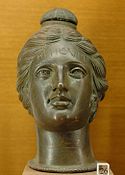
Etruscan perfume vase shaped like a female head
The word
perfume used today derives from the Latin
per fumus, meaning "through smoke". Perfumery, or the art of making perfumes, began in ancient
Mesopotamia and
Egypt and was further refined by the
Romans and
Persians.
Although perfume and perfumery also existed in
India, much of its fragrances are
incense based. The earliest distillation of
Attarwas mentioned in the Hindu Ayurvedic text Charaka Samhita. The
Harshacharita, written in 7th century in Northern India mentions use of fragrant
agarwood oil.
The world's first recorded chemist is considered to be a woman named
Tapputi, a perfume maker who was mentioned in a cuneiform tablet from the 2nd millennium BC in Mesopotamia. She distilled flowers, oil, and
calamus with other aromatics then filtered and put them back in the still several times.
In 2005, archaeologists uncovered what are believed to be the world's oldest perfumes in
Pyrgos,
Cyprus. The perfumes date back more than 4,000 years. The perfumes were discovered in an ancient perfumery. At least 60 stills, mixing bowls, funnels and perfume bottles were found in the 43,000-square-foot (4,000 m
2) factory.
[5] In
ancient times people used
herbs and
spices, like
almond,
coriander,
myrtle,
conifer resin,
bergamot, as well as
flowers.
The
Arabian chemist,
Al-Kindi (Alkindus), wrote in the 9th century a book on perfumes which he named
Book of the Chemistry of Perfume and Distillations. It contained more than a hundred recipes for fragrant oils, salves, aromatic waters and substitutes or imitations of costly drugs. The book also described 107 methods and recipes for perfume-making and perfume making equipment, such as the
alembic (which still bears its Arabic name).
The Persian chemist Ibn Sina (also known as
Avicenna) introduced the process of extracting oils from
flowers by means of
distillation, the procedure most commonly used today. He first experimented with the
rose. Until his discovery, liquid perfumes were mixtures of oil and crushed herbs or petals, which made a strong blend. Rose water was more delicate, and immediately became popular. Both of the raw ingredients and distillation technology significantly influenced western perfumery and
scientific developments, particularly
chemistry.
The art of perfumery was known in western
Europe ever since 1221, if we consider the monks' recipes of Santa Maria delle Vigne or
Santa Maria Novella of
Florence,
Italy. In the east, the
Hungarians produced in 1370 a perfume made of scented oils blended in an alcohol solution at the command of
Queen Elizabeth of Hungary, best known as
Hungary Water. The art of perfumery prospered in
Renaissance Italy, and in the 16th century,
Italian refinements were taken to France by
Catherine de' Medici's personal perfumer, Rene the
Florentine (Renato il fiorentino). His laboratory was connected with her apartments by a secret passageway, so that no formulas could be stolen en route. Thanks to Rene,
France quickly became one of the European centers of perfume and cosmetic manufacture. Cultivation of flowers for their perfume essence, which had begun in the 14th century, grew into a major industry in the south of France. Between the 16th and 17th century, perfumes were used primarily by the wealthy to mask body odors resulting from infrequent bathing. Partly due to this patronage, the perfumery industry was created. In Germany, Italian barber Giovanni Paolo Feminis created a perfume water called Aqua Admirabilis, today best known as
eau de cologne, while his nephew
Johann Maria Farina (Giovanni Maria Farina) in 1732 took over the business. By the 18th century, aromatic plants were being grown in the
Grasse region of
France, in
Sicily, and in
Calabria,
Italy to provide the growing perfume industry with raw materials. Even today, Italy and France remain the centre of the European perfume design and
trade.
Even in india , the Mugal emperor's wife , Mumatz Mahal had discoverded perfume , the same was referred to as 'ARK' meaning the extract of something . the earlier known perfumes were made by collecting the outer layer of roses dipped in the water for a long time , this layer was stored in some bottle & was used for fragnanace .
 This image was taken during one of my many trips to test the limits of my ML320. (Baja California October 1997 in this case)


